Ulick Norman Owen
Ulick Norman Owen is the pseudonymous mastermind behind the Indian Island murders, a figure who never appears in person but whose identity is gradually revealed to be the invention of the retired judge Lawrence John Wargrave. The name is a transparent cipher—U. N. Owen standing for "Unknown"—and the entire scheme is a meticulously planned act of extrajudicial execution targeting ten people whom the law could not touch.
Identity and Concealment
The name Ulick Norman Owen first appears in the correspondence that lures each guest to Indian Island. Vera Claythorne receives a letter signed "Una Nancy Owen" , while the judge receives one from "Constance Culmington" that mentions the Owens . The butler Rogers is instructed by a letter from "Mr. Owen" at the Ritz Hotel to play a gramophone record after dinner . It is the judge who first notices the pattern: the initials U. N. appear in both masculine and feminine forms, and he declares that "by a slight stretch of fancy, UNKNOWN" . He concludes that the guests have been invited by a madman—"probably a dangerous homicidal lunatic" . In truth, the judge himself is that madman, and U. N. Owen is his alias.
The Scheme and Its Execution
Wargrave's confession, written after the last death and sealed in a bottle, reveals that U. N. Owen was his creation from the start. He describes his lifelong "lust to kill" combined with a "strong sense of justice" , and his desire to commit "a fantastical crime—something stupendous—out of the common" . The nursery rhyme "Ten Little Indian Boys" provided the structure: each death would mirror a verse, and the diminishing china figures on the dining table would mark the progress . Wargrave selected his victims carefully, gathering information through casual conversations and his professional network. He used Isaac Morris to purchase the island and arrange the logistics, then killed Morris with a capsule before the party began . The order of death was calibrated to guilt: those with lighter offenses died first, sparing them prolonged terror . Anthony Marston and Mrs. Rogers were the first to die, by cyanide and chloral respectively . General Macarthur was struck from behind . Rogers was killed while chopping sticks . Emily Brent was injected with cyanide after being drugged with chloral in her coffee; Wargrave added a bumblebee to the scene to match the rhyme .
The Red Herring and Final Acts
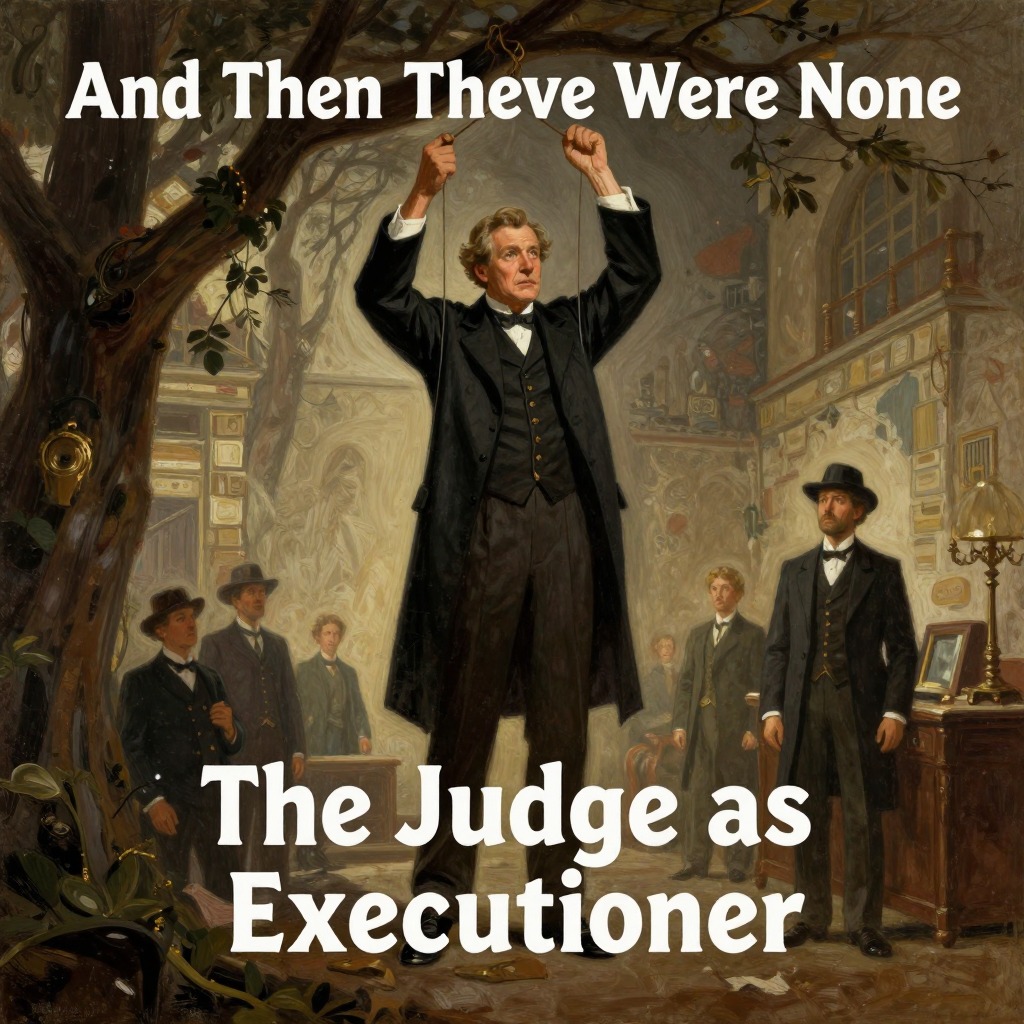
Wargrave staged his own death as the next victim, using red mud on his forehead, a scarlet curtain, and grey wool to simulate a bullet wound . He recruited Dr. Armstrong as an ally, then pushed him off a cliff into the sea—a "red herring" that swallowed the doctor . After Armstrong's drowning, Wargrave returned the revolver to Lombard's room and watched from the house as the remaining three destroyed each other. When Blore came up alone, Wargrave dropped the marble bear clock on him . From his window, he saw Vera Claythorne shoot Philip Lombard . He then set the stage in Vera's bedroom, hanging a noose from the hook; the hypnotic suggestion of the surroundings, combined with her guilt, led her to hang herself . Finally, Wargrave arranged his own suicide to look like another murder, using an elastic cord attached to his eyeglasses and the revolver, so that the gun would fall away from his body after he pulled the trigger .
Thematic Significance
U. N. Owen represents the ultimate critique of legal justice: a figure who operates entirely outside the law to punish those the law cannot reach. Wargrave's confession reveals his belief that he was an "artist in crime" , and his final act—throwing the confession into the sea—is driven by a "pitiful human wish that some one should know just how clever I have been" . The name itself, "Unknown," underscores the anonymity of the operation, but the clues Wargrave leaves—the guilt of Edward Seton, the red herring of Armstrong's death, and the brand of Cain on his own forehead —are designed for those clever enough to solve the puzzle. U. N. Owen is both the embodiment of Wargrave's megalomania and the novel's central mystery: a ghost who was always one of the ten.